Side Bet Dynamics and Their Role in Multi-Deck Blackjack House Edge Evaluations
Tina Bauer · Oct 31, 2026
Side Bet Dynamics and Their Role in Multi-Deck Blackjack House Edge Evaluations
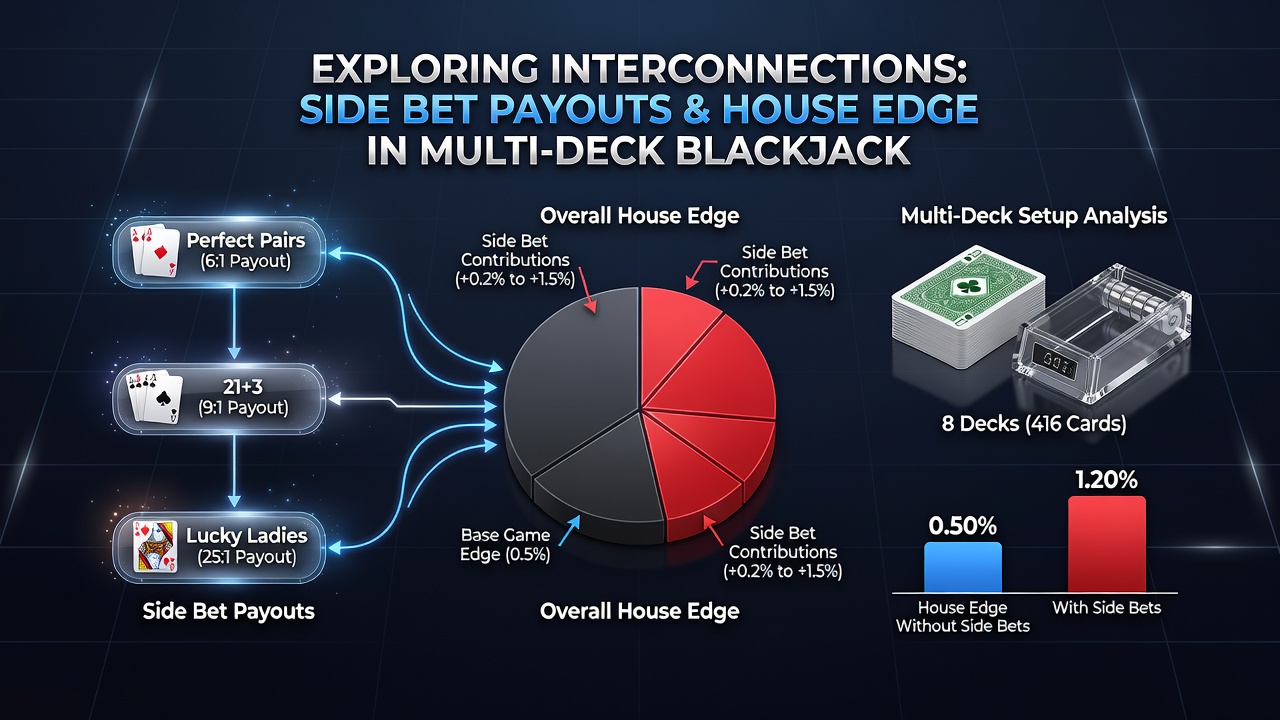
Blackjack side bets introduce separate wagering options that operate alongside the main hand, each carrying distinct payout ratios and probabilities that interact directly with the overall house edge when players participate in multi-deck formats. Researchers have documented how these additional bets modify the effective return rates because their payout structures often deviate from the core game's mathematical balance, particularly when six or eight decks remain in play throughout a shoe.
Data from regulatory reports indicate that side bet house edges typically range between 2 percent and 10 percent or higher depending on the specific wager and deck count, whereas the base game in multi-deck setups hovers closer to 0.5 percent under optimal play conditions. Observers note that when players combine side bets with the primary wager, the composite house edge rises in proportion to the frequency and size of those side wagers, since most side bet payouts fail to align with their true occurrence rates across shuffled decks.
Core Mechanics of Side Bet Payout Structures
Common side bets such as Perfect Pairs, 21+3, and Insurance rely on fixed payout multiples that remain constant regardless of deck penetration or remaining card composition in multi-deck games. Studies reveal that Insurance, for instance, pays 2 to 1 on a dealer ace upcard yet succeeds only when the remaining cards contain a ten-value ratio exceeding one-third, a threshold rarely met in six-deck or eight-deck configurations where tens are diluted across larger card pools.
Twenty-One Plus Three variants award payouts ranging from 9 to 1 for three-card poker combinations formed by the player's two cards and the dealer upcard, yet probability calculations show these combinations occur less frequently than the posted odds suggest once multiple decks enter the shoe. The resulting discrepancy creates a house edge that compounds when players place these bets repeatedly during sessions that span several shoes.
Impact of Deck Quantity on Probability Distributions
Multi-deck setups alter the baseline probabilities for side bet triggers because additional cards reduce the volatility of specific ranks and suits appearing in sequence. Evidence from gaming mathematics indicates that eight-deck shoes produce slightly lower hit rates for pair-based side bets compared with single-deck equivalents, since the likelihood of matching ranks decreases as the total card pool expands.
Those who have examined simulation outputs find that the house edge on Perfect Pairs rises modestly when moving from two decks to eight decks, primarily because the payout schedule stays fixed while the actual frequency of suited or unsuited pairs declines. This shift occurs even though the main blackjack hand retains similar optimal strategy returns across those same deck counts.
Composite House Edge When Side Bets Combine With Base Wagers
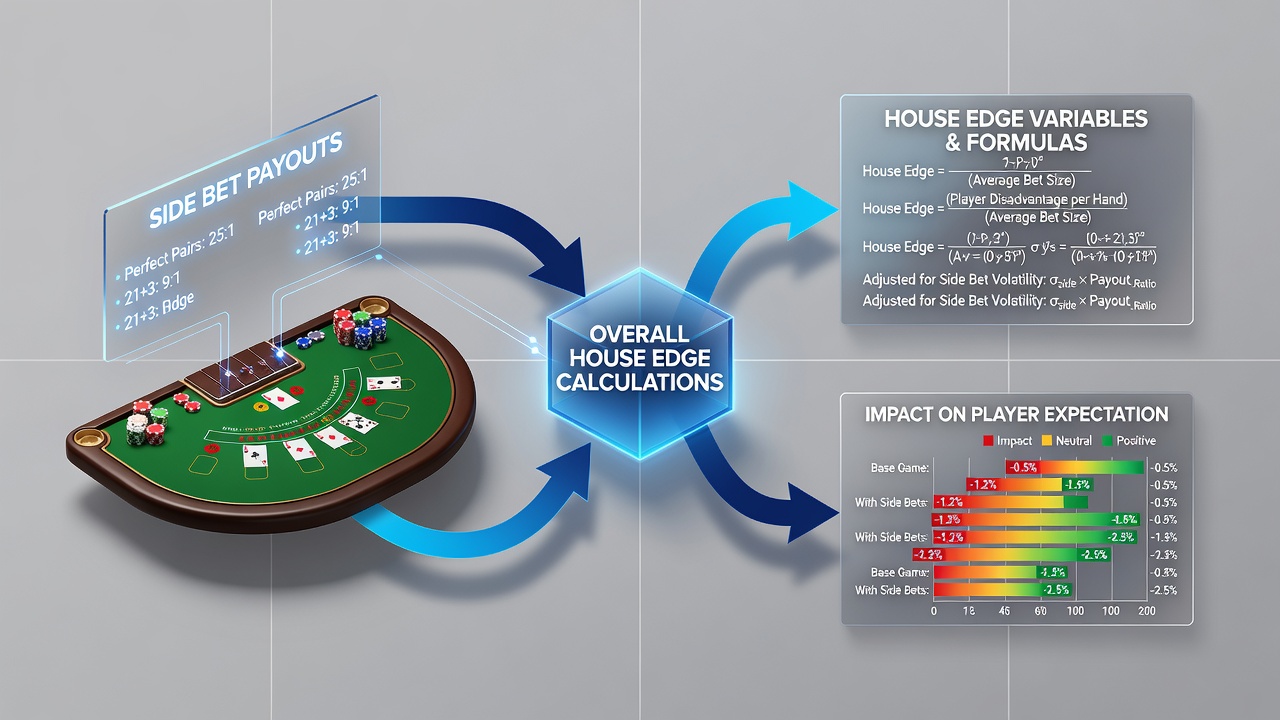
Calculations that integrate both main hand and side bet participation demonstrate that the aggregate house edge experienced by a player equals the weighted average of each component's individual edge based on bet size. When a player allocates 10 percent of total action to side bets carrying a 5 percent house edge, the overall disadvantage increases beyond the base game's 0.5 percent figure even if perfect basic strategy governs the primary decisions.
Industry analyses conducted by academic groups in Canada show that players who consistently add side bets throughout an eight-deck shoe experience composite edges between 1.2 percent and 3.8 percent depending on the particular side bet mix and wager proportions. These figures hold steady across typical table minimums and do not vary significantly with minor rule differences such as dealer hit or stand on soft 17.
Regulatory Data Releases Scheduled for October 2026
Updated statistical compilations scheduled for release by the Nevada Gaming Control Board in October 2026 are expected to provide fresh multi-deck side bet performance metrics drawn from statewide table reporting systems. Such data sets allow analysts to cross-reference observed payout frequencies against theoretical models, revealing any discrepancies introduced by real-world shuffling procedures or player behavior patterns.
Similar reporting cycles maintained by Australian state authorities already supply comparable longitudinal figures that researchers cross-check against North American datasets, confirming that side bet edges remain elevated relative to base game returns regardless of regional rule variations.
Conclusion
Side bet payout structures and multi-deck house edge calculations remain interconnected through fixed odds that fail to adjust for expanded card pools, resulting in measurable increases to overall player disadvantage when participation occurs. Available evidence from regulatory compilations and simulation studies consistently demonstrates that the magnitude of this increase depends on both the specific side bet chosen and the proportion of total wagers allocated to it. Players evaluating multi-deck blackjack options therefore encounter these mathematical relationships whenever side bets appear on the layout.